| Home | Chinatowns of the world | Festivals | Culture | Food Culture | History | Countries |
| Chinese Religion | Tours | Sitemap | Documentaries | About | Contact |
Eight Immortals
|
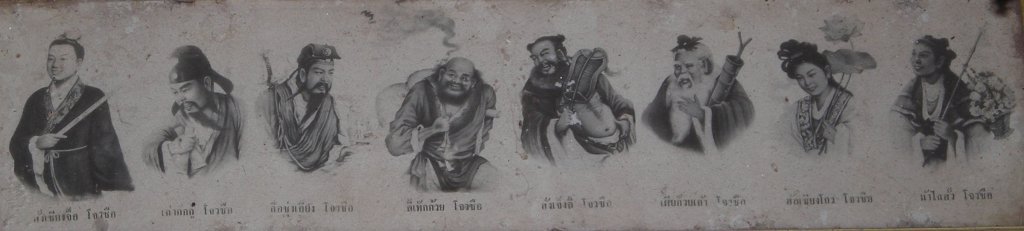
| Immortal | Emblem | Comments |
| Lu Dong Bin 呂洞賓 /吕洞宾 |
Sword | Leader of the 8 immortals |
| He Xian Gu 何仙姑 |
Lotus Flower | Only lady in the group |
| Cao Guo Jiu 曹國舅 / 曹国舅 |
Jade Tablet | Royal Uncle |
| Han Xiang Zi 韓湘子/ 韩湘子 |
Flute | Philosopher |
| Elder Zhang Guo or Zhang Guo Lao 張果老 /张果老 | Fish Drum | |
| Zhong Li of Han, Han Zhong Li 漢鐘離 / 汉钟离 Zhong Li Quan 鐘離權 / 鐘离權 |
Fan made of banana leaves | |
| Lan Cai He 藍采和/蓝采和 |
Bamboo flower basket | Described as a transvestite, transsexual or hermaphrodite |
| Iron-Crutch Li 鐵拐李 / 铁拐李 |
Gourd |
The Eight Immortals are very popular and have appeared in plays, depicted in art and presented in performances. During birthday banquets, families may arrange for a group of actors dressed as the Eight Immortals to wish the birthday person longevity and happiness. This is inspired by the legend of the Eight Immortals paying birthday respects to the Queen Mother of the West.
As the only group of eight in the Taoist pantheon, they are very easily to recognize. In fact, any representation with seven men and a woman is most likely a depiction of the Eight Immortals. Alternatively, they are symbolized by their emblems.
Popularity of the Eight Immortals
Two main reasons account for the popularity of the Eight Immortals.
The Eight Immortals are humans who have attained immortality. As humans, they faced challenges in life and have their imperfections that the common person can relate to. This theme is reflected in many stories that revolve around the Eight Immortals as a group and also as individuals.
The second and perhaps more important reason is the egalitarian nature of Taoism. The Eight Immortals represents a cross section of the Chinese or even human society; the scholar (Lu Dong Bin), royalty and social elites (Cao Guo Jiu & Han Xiang Zi), the elderly (Zhang Guo Lao & Han Zong Li), handicapped (Tie Guai Li)), women (He Xian Gu) and sexual minority (Lan Cai He).
In Taoism, individuals, as seen in the case of these eight immortals, achieve immortality through individual cultivation and virtues. While there are deities and immortals that can help, bulk of the responsibility rests on the individual. It is not dependent on the acknowledgment of a supreme god who needs to be praised or worshipped in exchange for immortality.
Symbol of egalitarianism
Therefore, the Eight Immortals reflects the egalitarianism that anyone regardless of background, age, gender identity can attain immortality.
Being so well respected, temples are of course dedicated to the Eight Immortals. They are commonly called Eight Immortal Palace, 八仙宫. Of the eight, only Lu Dong Bin is commonly often seen and worship on his own as the Progenitor, 呂祖, of the Quan Zhen sect of Taoism.
Related articles:
Culture & Customs
Taoism Main page
Taoist Pantheon
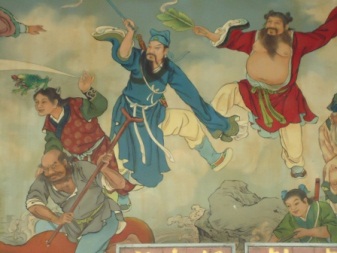
Wall mural of the 8 immortals, Bao An gong Taiwan
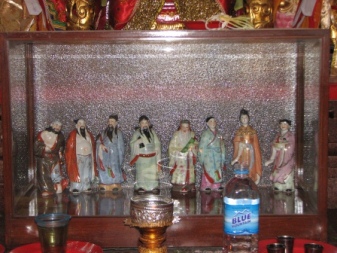
8 immortals worshipped at the Kheng Hock Keng,
Yangon, Burma
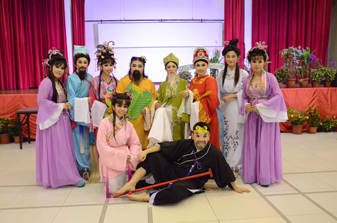
The Eight Immortals by Do Opera
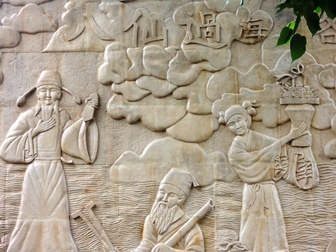
Jin De yuan, Jakarta Chinatown, Indonesia
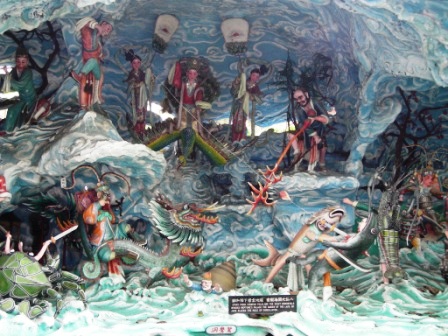
8 immortals battles the sea palace, Haw Par Villa singapore
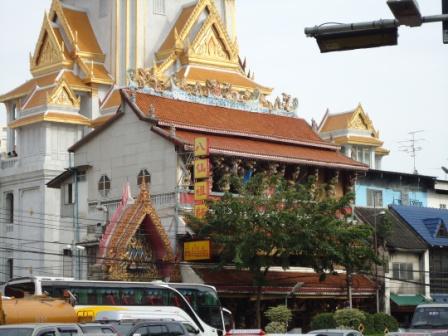
8 immortals temple in Bangkok Chinatown
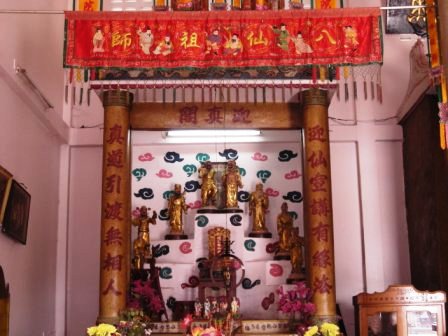
Shrine to the 8 immortals
Chinese temple in Vientiane, Laos
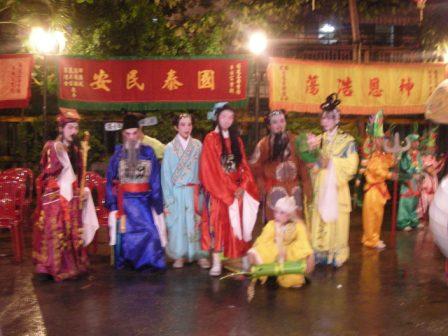
8 immortals, Mid Autumn celebration
Nhi Phu Club, Cholon, Saigon Chinatown
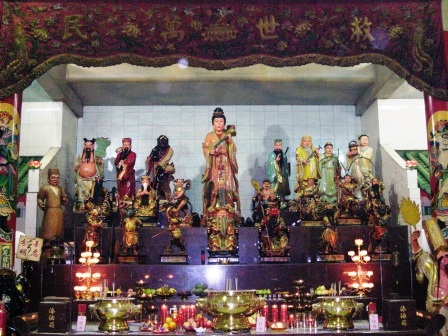
Shrine to the 8 immortals, Singapore
This temple is dedicated to He Xian Gu,
hence she is positioned in the center.
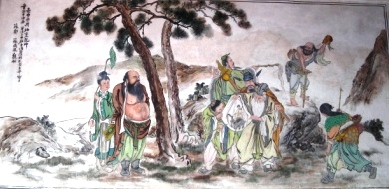
wall painting of 8 immortals, Tainan Grand Matsu temple
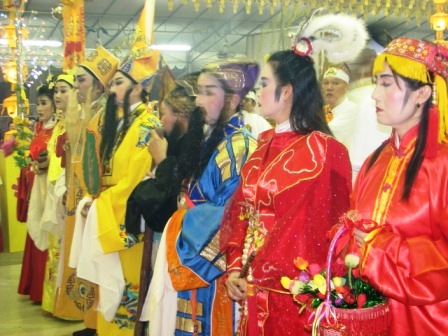
8 immortals in a 9 emperor gods celebration
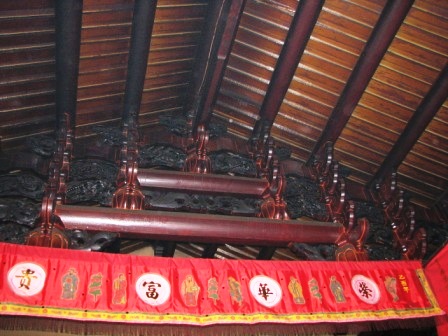
Figures of the 8 immortals on a banner
They appear in between the Chinese characters
| Join us on |  |
Youtube |  |
|
| Copyright © 2007-24 Chinatownology, All Rights Reserved. | ||||